 Main Menu | Advanced EVE | Assumptions
When entering the Advanced Economic Value of Equity (EVE) module, the display defaults to the Assumptions tab and the Discount Rates page.
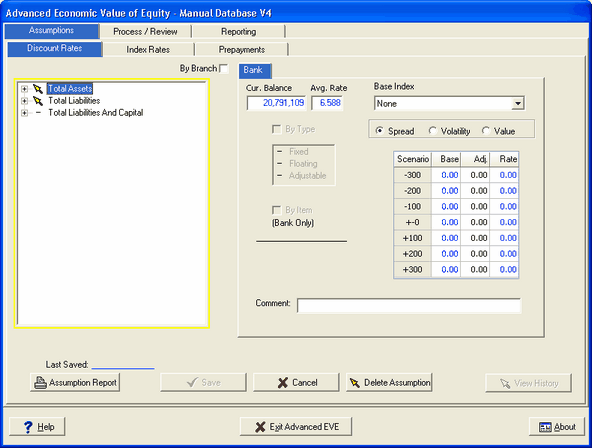
Three sets of assumptions are needed for the Advanced Economic Value of Equity module.
Discount Rates
The Advanced Economic Value of Equity relies upon the present value of future cash flows from each item in order to determine the value of equity in each rate shock environment. This is based on the "time value of money," the notion that a dollar someone gives you today is more valuable to you than one they promise to give you in the future, because it is more certain.
Thus, for each item you need projected cash flows and a "discount" rate at which to calculate the present values of those cash flows. How do you discount those cash flows? You generally use an interest rate that you would receive or pay, depending upon whether it is an asset or liability, to replace that item in the respective rate shock environment.
Index Rates
For variable rate (floating daily or periodically adjustable) items, the cash flows are more uncertain: as periodic interest payments can vary depending upon changes in an underlying index. Thus, for variable rate items, you need to make an assumption concerning the underlying index in the various shock scenarios.

Prepayments
Certain items, such as mortgages and mortgage-backed securities, are subject to prepayments of principal that will alter the cash flows associated with the principal. For these items, portions of the principal are paid prior to maturity, which increases the speed of the cash flow and shortens the life of the item. This also possibly reduces the number of periodic interest payments on the item. Thus, you also need to make an assumption concerning prepayments on items.