 Main Menu | Advanced EVE | Assumptions | Discount Rates
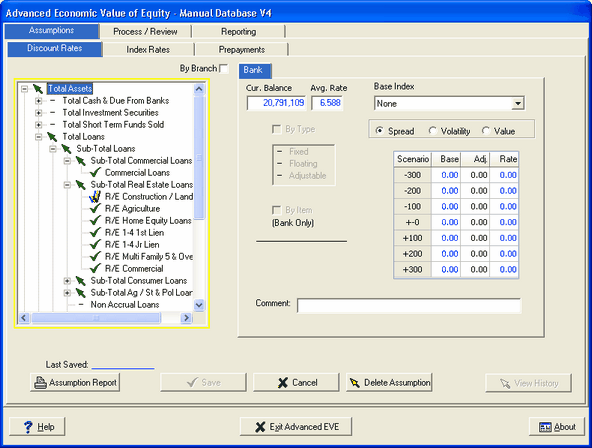
The Economic Value of Equity (EVE) is based upon the "present value" of all of the cash flows over time of each loan, investment, and deposit item on the institution's balance sheet. To determine this "present value," we need the projected cash flows of each item, calculated based upon the detail captured from the institution's data processing system. Then, for certain items, projected cash flows are adjusted based on the assumptions that you make concerning changes in index rates and prepayment rates in the shock scenarios.
A crucial concept to understand when considering present value is that a dollar you have today is worth more than a dollar that you will have sometime in the future. One reason for this is that you could invest that dollar today and generate a return on it. Even if you do not invest that dollar, you could enjoy it today by purchasing something rather than putting off that purchase and enjoyment until the future. That is why you earn a rate of interest when you put a dollar into a savings account: you are being compensated for deferring gratification. Another reason a dollar is worth more today than in the future is inflation: a dollar in the future may not purchase as much as a dollar today.
The interest rate, or return, on your investment is crucial in determining the value of the investment. The lower the interest rate a dollar earns today, the more valuable the stream of future earnings becomes, and vice versa. In other words, the more you would earn on that dollar today, the less likely you will be to defer receiving that dollar into the future. In the case of higher rates, you would want to receive your money quickly so that you could reinvest it at a higher rate.
To measure the present value of a cash flow, we need an interest rate at which to value or "discount" those cash flows. As we noted above, you earn a rate of interest when you defer your use of your money by investing it or saving it. That rate of interest must be perceived as sufficiently high enough to make you defer the gratification of using your money otherwise. This suggests that rate of interest you would receive today would provide a good measure against which to value the projected cash flows.
But what if the environment changes and interest rates go up or down? In such a case, you may not be able to replace your current investment or savings account at the same rate. This suggests that it would be more appropriate to value the cash flow against the interest rate you would obtain if you had to replace the investment or savings account in the prevailing environment. If rates fall 100 basis points, at what rate would you be willing to make the same investment? Thus, we will need to make assumptions about the discount rates in the various rate shock environments.
Fortunately, the above discussion suggests that we have some benchmarks to help us make those discount rate assumptions. For most loans, investments, and deposits, the interest rate that we would receive or pay for that instrument in the various rate environments will be the appropriate rate at which to discount the instrument in that environment. In other words, if we would make a certain fixed rate loan at 6% in a down 100 basis point shock scenario, then that would be the appropriate rate at which to discount that particular fixed rate loan.
A good source of these kinds of loan and deposit pricing data would be found in your institution's Funds Management or Asset/Liability (ALCO) committees.